
9-Day Hiking Kilimanjaro (Machame Route)
FROM $2,400.00 USD* / BREATHTAKING SUMMIT VIEWS / 9 DAYS
* Indicative costs per person, excluding international airline tickets

Photo by Crispin Jones
Kilimanjaro is the goal — Machame is how you want to get there. Widely regarded as the most scenic of the routes, it opens with rainforest, then views across to Mount Meru, and puts you underneath the Barranco Wall for a scramble that most people remember longer than the summit itself. The profile matters as much as the scenery: Machame takes you high to Lava Tower and back down to sleep low, which is why trekkers on the 7-day version reach Uhuru Peak far more often than on the shorter alternatives. And because you descend by a different path than you came up, you see the mountain from two sides in one trip.
It is a demanding walk, not a stroll — six to seven days, steep sections, thin air. That’s the point. Standing on the crater rim at sunrise is worth what it costs you to get there.
Price
April - May
-
2 persons
-
4 persons: $2,300.00 USD*
-
6 persons: $2,100.00 USD*
Rest Of The Year
-
2 persons
-
4 persons: $2,700.00 USD*
-
6 persons: $2,500.00 USD*
July - September
-
2 persons
-
4 persons: $2,900.00 USD*
-
6 persons: $2,700.00 USD*
Included
- 24/7 service
- Pickup and transfer from/to airport
- Park fees
- English-speaking guide
- Private cook
- Porters who carry your luggage
- Portable toilette
- Tents and shelter
- Reservation costs
- Rescue fee (up tp 11.483 feet above sea level by car)
Excluded
- Visas
- Travel insurance
- International flights
- Tipps for guides, porters and cooks
Route

Itinarary
Day 1: Arrival at Kilimanjaro International Airport
Your guide is waiting when you land at Kilimanjaro International. Short transfer to the hotel, and then the day is yours — sleep off the flight, eat something, stay off your feet.
The briefing. Before you climb, your guide sits down with you and goes through the mountain properly: the route, the pace, what altitude will feel like on day three, and what to do when it does.
Then the gear check, and we do this seriously. Boots, layers, sleeping bag, headtorch, gloves for a summit night that runs well below freezing. If something in your bag won’t hold up, better to find out in Moshi where it can be replaced than at 4,600 metres where it can’t. Anything you’re missing, we’ll sort it.

Photo by Stephan Bechert
Day 2: Machame Route (1/7) | Machame Gate (1.800 m) - Machame Camp (2.835 m)
1,800 m → 2,835 m · 5–6 hours
Morning pickup from the hotel and a drive to Machame Gate, where the permits get signed, the loads get weighed, and the mountain starts.
The first day is rainforest — proper rainforest, dense and dripping, with colobus monkeys somewhere overhead and mud underfoot regardless of the season. The trail climbs steadily rather than steeply. It’s the easiest walking of the week.
Which is the trap. Almost everyone goes too fast on day 2, because they can. Your guide will hold you to pole pole — slowly, slowly — and it will feel absurdly unhurried. Trust it. The people who summit on day 7 are the ones who were bored on day 2.
Camp sits at the top of the forest, just below where the trees give out. Drink more than you think you need, and eat even if you don’t feel like it.
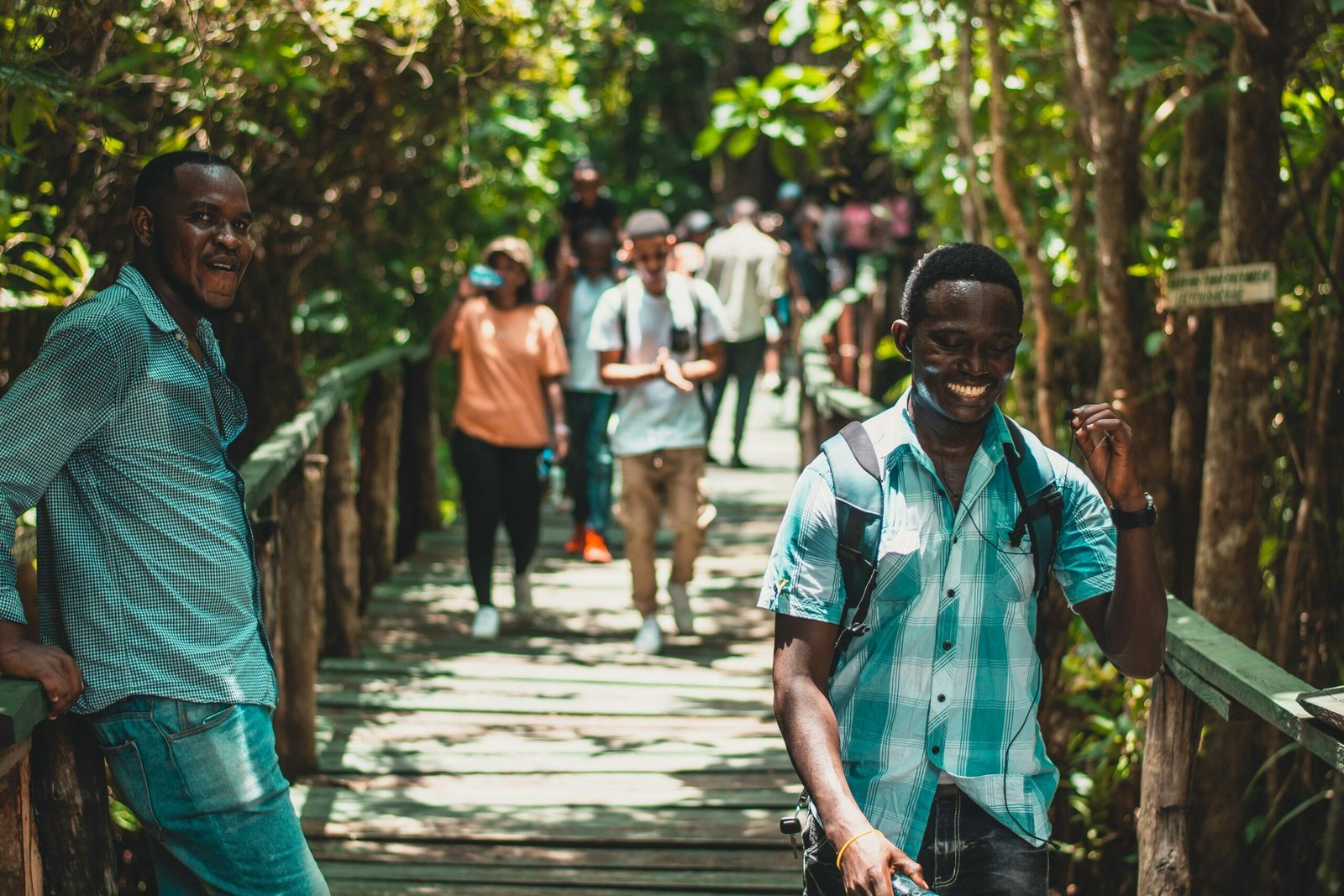
Photo by Andrew Kayani
Day 3: Machame Route (2/7) | Machame Camp (2.835 m) - Shira Camp (3.839 m)
2,835 m → 3,839 m · 5–6 hours
The trees end today. Within the first hour you climb out of the forest and the whole world opens up — heather, giant lobelia, bare rock, and sky in every direction. It’s the day people take the most photographs.
You’ll stop at Picnic Rock, a small outcrop on the ridge with Kibo standing there in front of you for the first time. It’s the first honest look at what you’ve signed up for.
From there the trail eases onto the Shira Plateau — the floor of Kilimanjaro’s third volcano, which collapsed and eroded long ago. Camp sits out on the open plateau at 3,839 m.
That’s a thousand metres of gain in a day, the biggest of the week. Expect a headache in the evening; most people get one. Tell your guide about it rather than toughing it out — that’s what they’re there for. If there’s time and everyone’s feeling strong, there’s a short acclimatisation walk up the ridge before dinner. Worth doing.

Photo by Tom Cleary
Day 4: Machame Route (3/7) | Shira Camp (3.839 m) - Lava Tower (4.630 m) - Barranco Camp (3.950 m)
3,839 m → 4,630 m → 3,950 m · 6–7 hours
The strangest day on the mountain, and the most important one.
You climb east across the plateau into thinner, colder air, and by lunchtime you’re standing at Lava Tower — a black volcanic plug at 4,630 m, higher than anywhere in western Europe. Then you turn around and walk back down 680 metres to sleep.
That’s not a detour. That’s the day working. Your body spends four hours at altitude, registers that it needs more red blood cells, and then gets a night low enough to recover and build them. Climb high, sleep low. It’s why seven days beats five, and it’s why people summit off this route.
Be ready to feel rough up there. Headache, no appetite, a general sense of being flattened — that’s normal at Lava Tower and it usually lifts on the descent. Tell your guide anyway. They’re watching for it and they’d rather hear it early.
You drop into the Barranco valley through giant groundsel, plants that grow nowhere else on earth, and camp at the foot of the Barranco Wall. It rises straight out of the campsite and looks impossible from below.
That’s tomorrow.
Photo by Crispin Jones
Day 5: Machame Route (4/7) | Barranco Camp (3.950 m) - Karanga Camp (4.040 m)
3,950 m → 4,040 m · 4–5 hours
You wake up underneath it. The Barranco Wall goes up 250 metres directly behind camp and from below it looks like something you’d need ropes for.
You don’t. It’s a scramble on a well-worn path — hands on rock in a few places, one awkward step where the trail hugs the face, and your guide goes ahead of you through all of it. People who arrive dreading this day usually come down calling it their favourite. It takes about an hour and a half.
At the top you get Kibo close enough to read the glaciers, and Meru on the horizon behind you.
Then a shorter day than it sounds: down into the Karanga valley, back up the other side, and into camp by early afternoon. Short is deliberate. You gain ninety metres today and spend the rest of the afternoon at 4,000 m doing nothing, which is exactly what your body needs before tomorrow. Eat, drink, rest. If there’s energy left, a walk up the ridge toward Barafu helps.

Photo by Daniel Vargash
Day 6: Machame Route (5/7) | Karanga Camp (4.040 m) - Barafu Camp (4.645 m)
4,040 m → 4,645 m · 4–5 hours
A short walk, and then the strangest afternoon of the trip.
The trail runs up a bare alpine desert — no plants, no shelter, just rock and scree and the summit sitting there in front of you all morning. You’re in camp by early afternoon.
Barafu means ice in Swahili. It’s a camp pitched on rock at 4,645 m, exposed to whatever the mountain is doing, and it isn’t comfortable. It isn’t meant to be. You’re not staying.
The rest of the day runs backwards. Early dinner, kit laid out, water bottles filled, headtorch and batteries checked, and then you go to bed in daylight and try to sleep. Most people barely do. That’s normal — a few hours of lying still at altitude does more good than you’d think.
Your guide will wake you around 11pm.
On the optional walk to Kosovo Camp: some people go, most don’t. Your guide will make the call based on how you’re moving. If they say rest instead, rest — nothing you gain from an extra 200 metres this afternoon outweighs starting summit night with something in the tank.

Photo by Daniel Vargas
Day 7: Machame Route (6/7) | Barafu Camp (4.645 m) - Uhuru Peak (5.895 m) - Millenium Camp (3.820 m)
4,645 m → 5,895 m → 3,820 m · 12–15 hours
You’ll be woken around 11pm. Tea, something to eat that you won’t want, and then you walk out into the dark.
Six or seven hours of switchbacks up frozen scree, in a line of headtorches, at maybe half your normal walking speed. It is cold — well below freezing, colder in the wind — and it is relentless. There’s no technical difficulty in it. There’s just the altitude, the dark, and the fact that it doesn’t stop.
This is the hardest thing most people who climb Kilimanjaro have ever done. We’d rather you knew that now.
Around dawn you reach Stella Point on the crater rim, and the sun comes up over Mawenzi while you’re standing there. From there it’s another 45 minutes along the rim to Uhuru — the highest point in Africa, 5,895 metres, glaciers on one side and the whole continent falling away on the other.
You won’t be up there long. Fifteen, twenty minutes. Photographs, and then your guide will move you down, because nobody recovers at that altitude and every metre of descent helps. That isn’t your guide rushing you. That’s your guide doing their job.
Then the long way back: down to Barafu for a rest and something to eat, and on to Millennium Camp at 3,820 m. Go carefully — the descent is loose underfoot and your legs will be finished. More people get hurt going down this mountain than coming up.
You’ll sleep tonight.

Photo by Crispin Jones
Day 8: Machame Route (7/7) | Millenium Camp (3.820 m) - Mweka Gate (1.800 m)
3,820 m → 1,640 m · 4–5 hours
You wake up able to breathe properly for the first time in a week. That alone is worth the morning.
The walk down goes back through everything in reverse — heather, then moorland, then into the forest, which after five days above the treeline smells overwhelming. It’s warm, it’s often wet, and it’s steeper than you want it to be.
Don’t let anyone tell you this part is easy. It’s 2,200 metres of descent on legs that finished yesterday, and it’s where knees and ankles pay for the summit. Poles help. Slow helps more.
Before you reach the gate. Your crew will gather for a send-off — singing, usually the Kilimanjaro song, and then the tipping. Come prepared for it. We send you guideline amounts and the recommended split between guides, cook and porters well before you fly, and we’d rather you arrived knowing than be caught out at the gate with no cash. Bring it in small notes.
At Mweka Gate you sign out and collect your summit certificate. Then a driver, a hotel, a shower, and a bed that isn’t on a rock.
Photo by Crispin Jones
Day 9: Departure (from Arusha International Airport)
Late checkout, and the strange feeling of walking on flat ground.
Your driver collects you for Kilimanjaro International in time for your flight. Most international routes leave in the evening, so there’s usually a slow morning and a last meal before you go.
One last thing. A share of what you paid for this climb goes into the biodiversity and community work we support in Tanzania. We’ll send you a note afterwards saying where it went — not a brochure, just the actual projects. You walked up the mountain; it seems right that you know what came of it.
And if you’re not ready to leave: the Serengeti and Ngorongoro are a few hours west, and Zanzibar is a short flight east. Plenty of people finish the climb and decide they’ve earned a beach. Tell us before you book and we’ll build it in.

Photo by Aron Marinelli